



Žiga Jenko
Certified apitherapist (NPK) · About the author
Everyone knows that bees sting. What is less well known is what actually happens: where the venom is made, how the sting is built, why a bee dies in one case but not in another, and how much venom goes into a single sting.
The venom gland and the venom sac
Bee venom is produced in the venom gland: two long, thin, coiled tubules in the abdomen. The secretion drains into the venom sac, a small reservoir where it collects and waits until the bee needs it. The wall of the sac has no muscles, so it cannot squeeze the venom out by itself; that is done by the muscles at the end of the sting apparatus [9].
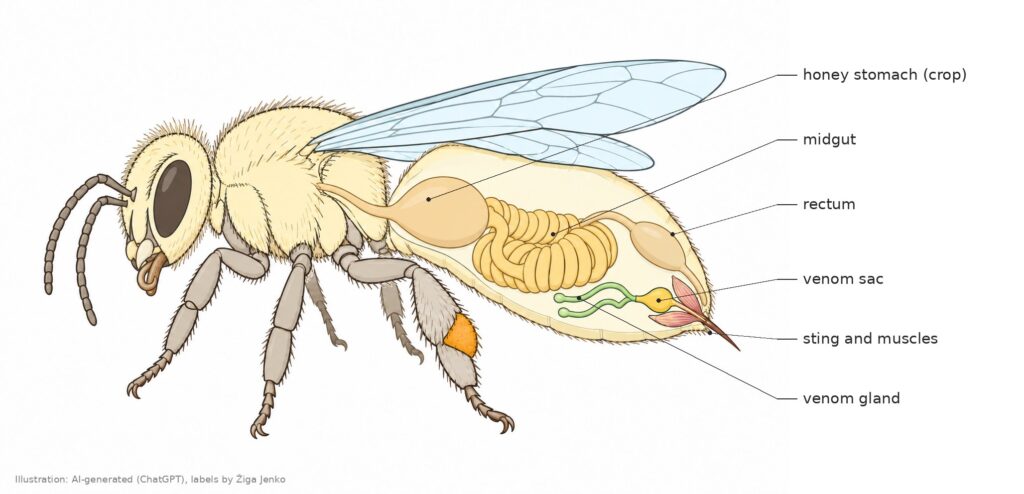
A bee emerges with a fully developed venom gland but an empty venom sac [24, 9]. Venom starts to build up in the first days of life and peaks at two to three weeks of age [23, 61]. After that the gland begins to degenerate and stops working by about day 30; workers are thought to be able to use their venom for the first time at around 14 days, just before the peak [9].
A full sac holds about 0.3 mg of venom [61, 24]. How much it contains depends on the season, the age of the bee and the forage. The gland needs protein to work, which means pollen in the diet [23].
Venom content declines towards autumn and stays at the same level over winter, so stings in late autumn and early spring are less painful and less potent [24].
How the sting is built and what happens when a bee stings
The sting did not evolve as a stand-alone weapon. In bees, wasps and ants it is a modified ovipositor, the organ their ancestors used to lay eggs [54]. That is why only females have a sting. According to the Slovenian Beekeepers’ Association (ČZS) booklet, it is formed from the modified eighth and last segment of the abdomen (a bee’s abdomen is made up of segments) and sits inside the seventh segment [23].
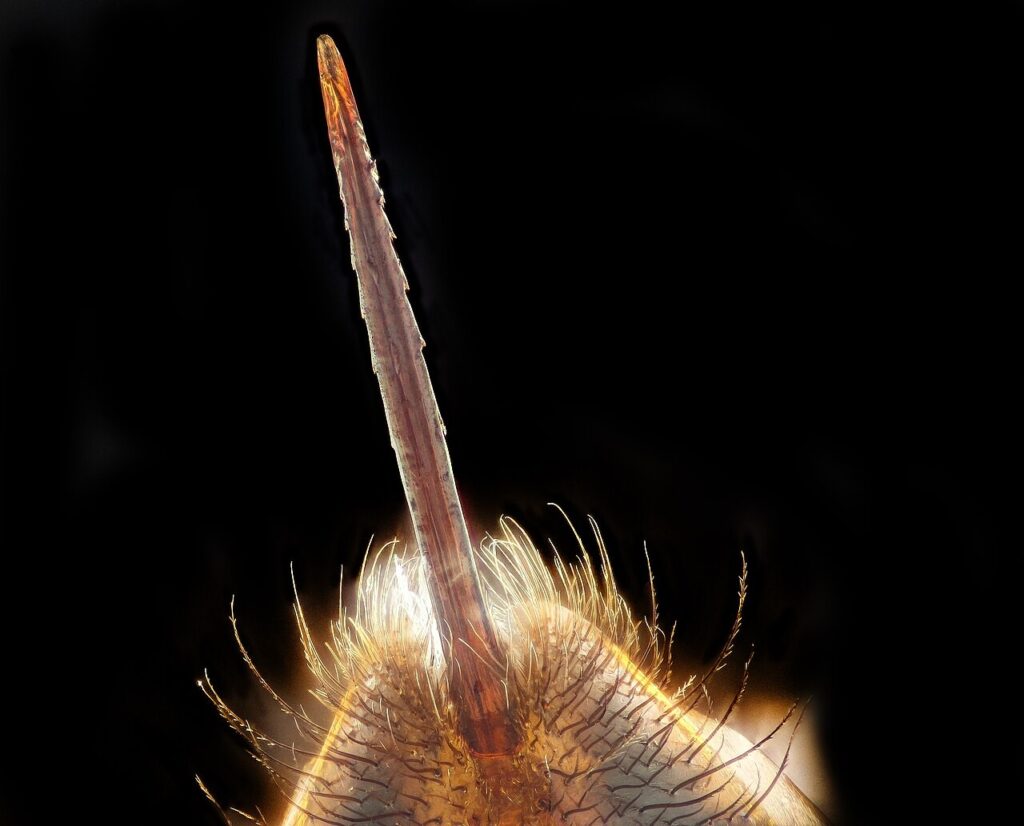
A honey bee sting consists of a stylet and two lancets. The stylet is the rigid part of the sting, with a groove in which the two lancets slide: thin needles with serrated outer edges. Each lancet carries 9 to 10 backward-pointing barbs [24, 50]. According to ČZS, the stylet ends in three pairs of small lateral teeth [24]. In the honey bee the stylet is too narrow to cover the barbs of the lancets, which is why its sting is harder to pull out of skin [51]. The venom canal runs between the two lancets. Venom is pushed into the sting as the lancets move alternately into the wound, and the barbs draw the sting ever deeper [23, 24, 50].
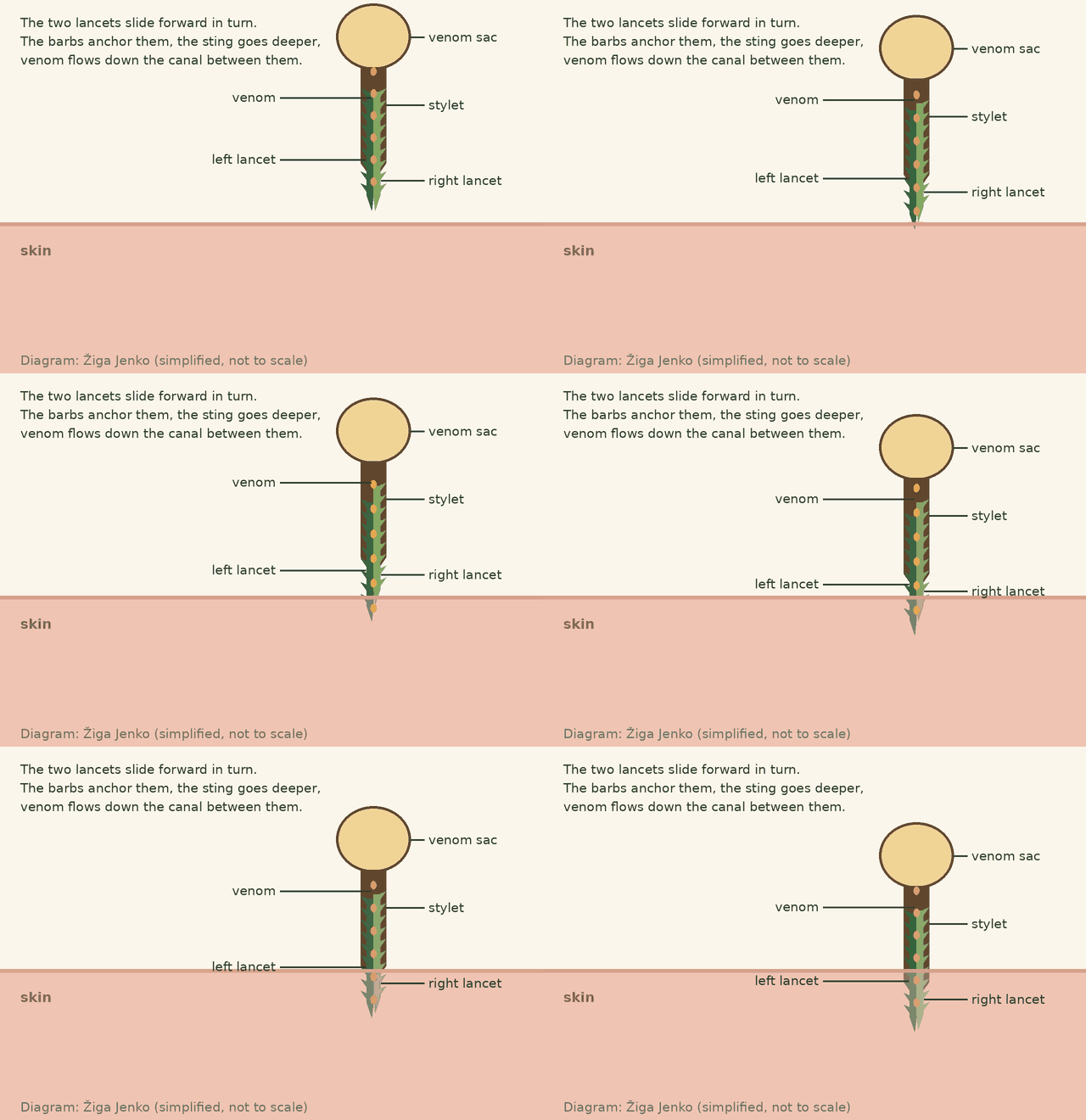
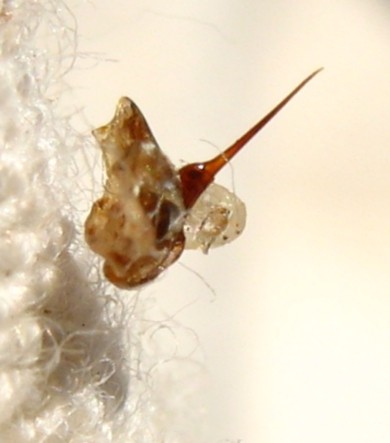
The sting chamber also holds, together with the sac, muscles, nerve ganglia and the end of the gut [50]. This is why a sting torn from the bee keeps working on its own for a while. It has its own muscles and ganglia, and the muscles pump out the entire contents of the sac. So it is important to remove the sting straight away, without squeezing the sac [23].
Does a bee die after stinging?
The answer: it depends on what it stings. What happens is decided by the surface, not by the bee.
Stinging mammalian skin
Mammalian skin is elastic. When the lancets dig in, the barbs catch and the wound closes around them. As the bee tries to pull away, it tears out its sting together with part of its internal organs [24]. It usually dies soon afterwards. According to Bee Culture magazine, the cause is the rupture of the abdomen, not the loss of venom as such [55].
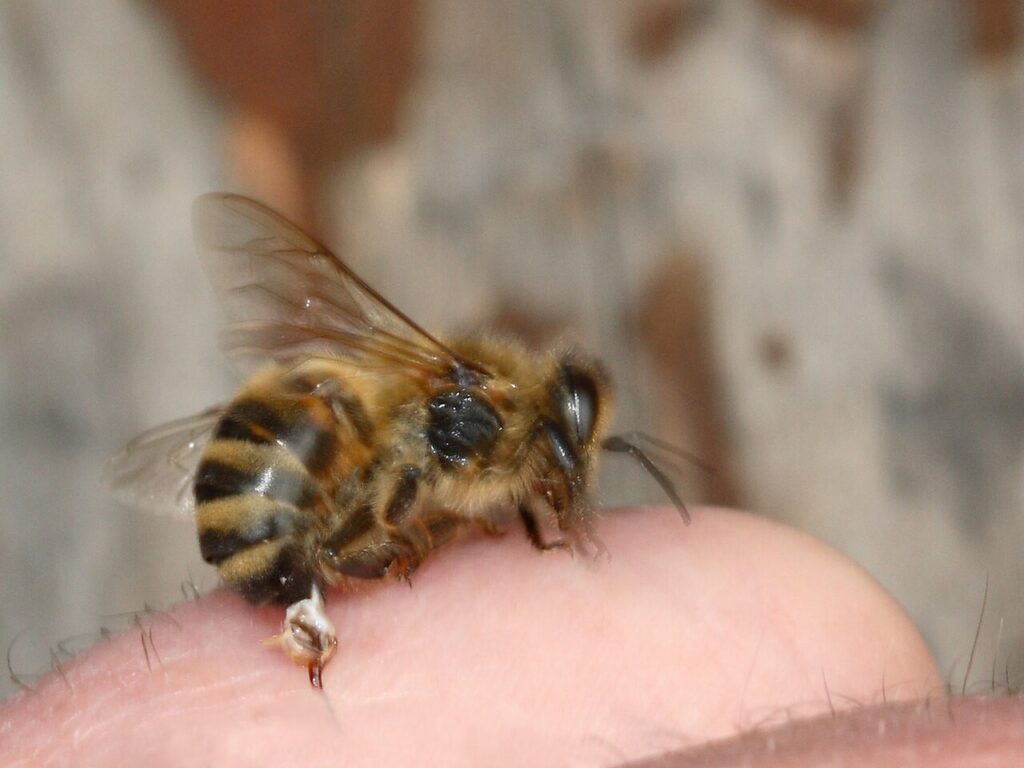
A bee that stings a mammal cannot sting again. The queen does not use her sting to defend the colony but mainly against rivals, other queens [9].
Stinging another insect
It is different when a bee stings another insect. Chitin, the hard outer shell of insects, does not close around the sting, and the bee pulls it back out, the way you would pull a needle out of an apple. The bee survives and can sting again [24, 54, 55].
How bees defend themselves: two stories
A hot ball against the hornet
The Japanese honey bee, Apis cerana japonica, defends itself against the hornet Vespa mandarinia japonica with heat. When a hornet lands in front of the hive, more than 500 bees surround it and pack it into a ball in which the temperature rises to about 47 °C. This is lethal for the hornet but does not harm the bees [58]. The story is usually told as one about overheating, not stinging.
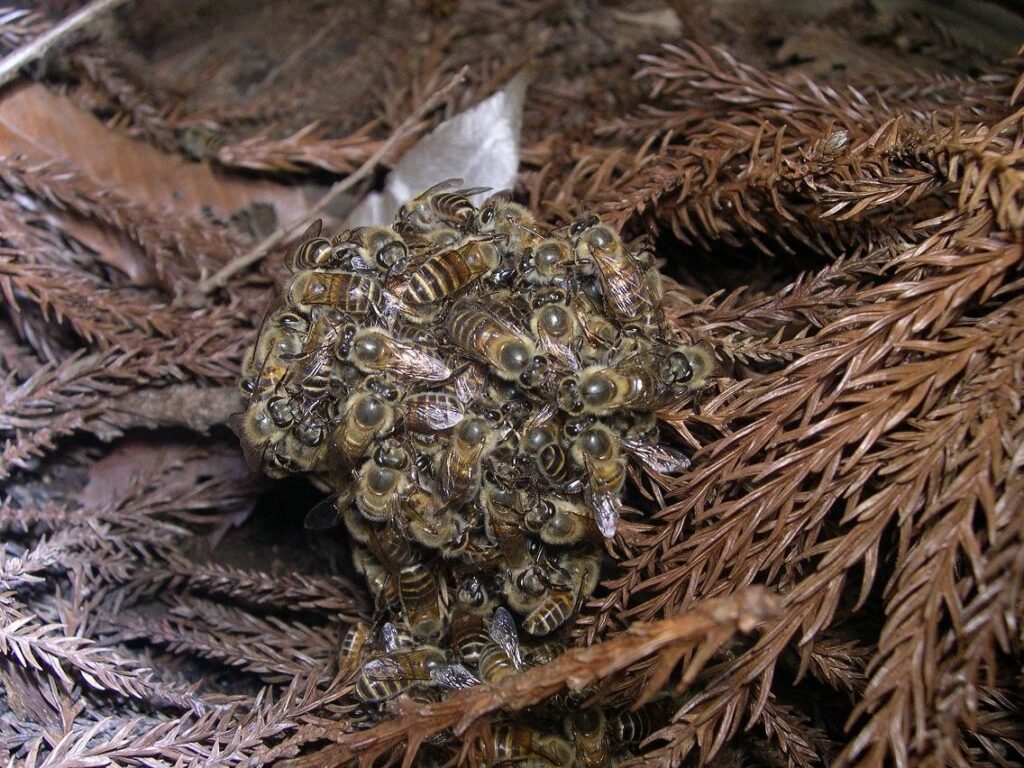
A more recent study adds to it. In the hornet Vespa velutina, researchers tested both heat and stings. Heat alone reduced survival by a quarter after three hours, while stings at 44 °C cut survival by more than half again compared with stings at normal temperature. Stings alone were also lethal to the hornet, the more so the more stings it received. Of 30 hornets caught in bee balls at the hive, 10 had stings in them, mostly in the soft, neck-like area between body segments. Most hornets (87 %), however, pulled the sting out within a minute, so fewer stings are found on them than they actually received [59]. The study tested the stings of both species, the Asian honey bee (Apis cerana) and our honey bee, and both were lethal. So bees defend themselves against hornets with both venom and heat.
Bees and the head of a large attacker
With large predators that are mammals, the target is different. Attacking bees often aim at the area around the head. The reason lies in the cues that trigger an attack: alarm pheromone (the scent with which a stinging bee calls others, and which smells of bananas), vibration, carbon dioxide from breathing, hair and dark colours. Mammals are usually hairy and breathe out carbon dioxide, and all of this is concentrated around the head [60]. The often-told story that bees sting a bear or a person in the eyes and nose fits these reasons.
How much venom is in a bee and how many stings make a gram of dried venom
The figures vary between sources.
- In a normal sting a bee releases on average about 0.1 mg of venom [22]. So it does not inject everything at once: according to Simics, roughly a third [61].
- Fresh venom is mostly water. Sources give 55 to 70 % water [23, 22, 61, 62]. So 0.3 mg of fresh venom gives about 0.1 mg of dry venom at 65 to 70 % water.
- One gram of dried venom takes about 10,000 full venom sacs; sources often simply give this as 10,000 stings [10, 19, 22, 61]. Simics explains the calculation: a sac holds about 0.3 mg of fresh venom, which loses 65 to 70 % of its weight on drying, leaving about 0.1 mg of dry venom, and 10,000 sacs give 1 g [61]. Since a bee releases only about a third of its sac in a sting, the number of actual stings is about three times higher, around 30,000 (my own calculation).
Pollen determines the quality and quantity of bee venom
The venom gland needs protein, so venom quality is tied to forage and to the colony’s pollen supply at the time the bees that will produce the venom are developing [23]. In the ČZS study, a weak positive relationship between pollen stores in the combs and the amount of venom was found in some years [23]. It is a reminder that venom, too, is a seasonal product.
Next time
In the third note I describe how venom is collected: how it is obtained with a glass plate and a mild electrical pulse, why the bee does not die in the process, how the venom is dried and cleaned, and what determines its quality.
Sources
[9] Bee Culture: A Closer Look: Venom/Venom Glands (summarises Roat et al. 2006 and Martin et al. 2005, among others). https://beeculture.com/?p=10806
[10] Samancı T., Kekeçoğlu M.: Comparison of commercial and Anatolian bee venom in terms of chemical composition. Uludağ Arıcılık Dergisi 2019; 19(1): 60 to 67. Gives the figure of 10,000 stings after Hider 1988; I have not read Hider’s paper. https://dergipark.org.tr/en/pub/uluaricilik/article/527986
[19] University of Sarajevo: article on bee venom (pH, amount per bee, collection). https://radovi.ppf.unsa.ba/index.php/rppf/article/download/170/174/516
[22] Apitherapy Section of the Maribor Beekeepers’ Association: presentations Bee Venom 1 to 3 (including Methods, devices, venom storage; V. Pušnik and A. Lunežnik, 2020/21) and Bee venom: apitoxin. Read as presentations, no web link.
[23] Golob S., Košnik M.: Čebelji strup (Bee venom). Slovenian Beekeepers’ Association, Public Advisory Service in Beekeeping, Brdo pri Lukovici 2024 (ISBN 978-961-6516-93-8). No web link; the booklet exists in print and PDF; I read the PDF.
[24] Slovenian Beekeepers’ Association: Čebelji strup (Bee venom). https://czs.si/izobrazevanje/o-cebelah/cebelji-pridelki/cebelji-strup/
[50] Barbs Facilitate the Helical Penetration of Honeybee (Apis mellifera ligustica) Stingers. PLOS ONE, article e103823. https://doi.org/10.1371/journal.pone.0103823
[51] Mulfinger L.M. et al.: Sting morphology and frequency of sting autotomy among medically important vespids and the honey bee. Journal of Medical Entomology 1992; 29(2): 325 to 328. https://doi.org/10.1093/jmedent/29.2.325
[54] Wikipedia: Stinger (on bee stings and autotomy; summarises Eisner, Eisner, Siegler: Secret Weapons, 2005). Secondary source. https://en.wikipedia.org/wiki/Stinger
[55] Bee Culture: Do bees die after they sting you? Secondary source. https://beeculture.com/do-honey-bees-die-after-stinging
[58] Ono M., Igarashi T., Ohno E., Sasaki M.: Unusual thermal defence by a honeybee against mass attack by hornets. Nature 1995; 377: 334 to 336. I read only the abstract. https://doi.org/10.1038/377334a0
[59] Gu G., Meng Y., Tan K., Dong S., Nieh J.C.: Lethality of Honey Bee Stings to Heavily Armored Hornets. Biology 2021; 10(6): 484. https://doi.org/10.3390/biology10060484
[60] Voeller D., Nieh J.: Analysis of Honeybee Aggression (web page of J. Nieh’s laboratory, University of California, San Diego; cites Crane 1990). https://labs.biology.ucsd.edu/nieh/TeachingBee/honeybee_aggession.htm
[61] Simics M.: Bee Venom: Exploring the Healing Power. Apitronic Publishing, 1994. No web link (PDF).
[62] Bogdanov S.: The Bee Venom Book, chapter 1. Bee Product Science, 2016. https://www.bee-hexagon.net