



Žiga Jenko
Certified apitherapist (NPK) · About the author
Bee venom (apitoxin) is the secretion of the venom gland of worker bees. In nature, bees use it to defend the hive and their food stores against intruders, and people have long used it because of the proteins and peptides it contains [23, 61]. In this note I describe how venom is collected today, where in the hive and when we collect it, how we dry, scrape and store it, how we protect ourselves while doing so, and how to recognise good venom.
IN SHORT
Today venom is collected with a device that stimulates the bees with weak electrical pulses. The bee stings a glass plate, leaves a droplet of venom, keeps its sting and survives [23].
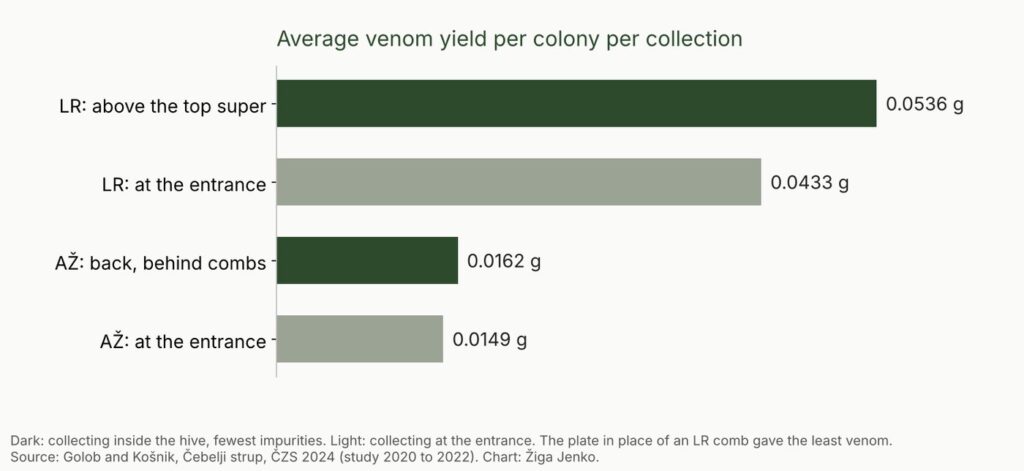
In the study by the Slovenian Beekeepers' Association (ČZS), LR hives with the collecting plate placed above the top super gave the most venom: on average 0.0536 g per colony per collection [23].
Slovenian samples from 2023 and 2024 contained 59.85 % melittin on average, and in 2024 half of the samples had between 69.4 and 71 %. The 2024 brochure of the Slovenian Beekeepers' Association rates this as an exceptionally high share compared with foreign studies [23].
From tweezers to the glass plate
For a long time, collecting venom was slow work. Its use was limited to placing live bees on the body, or to methods in which bees were made to sting glass or another surface by mechanical or chemical stimuli [23]. In the 1930s the German company Heinrich Mack collected venom like this: women in protective clothing sat beside the hives, caught bees with long tweezers and forced them to sting into absorbent paper [61].
The first device for collecting larger amounts of venom was developed in Czechoslovakia in 1954 by Markovič and Molnár. The bees were stimulated by an electric shock, and under the wire grid there was a rubber membrane. The barbs of the sting caught in the rubber, the bees lost their stings and most of them died, so the method was not economical [61].
In 1963 Benton, Morse and Stewart described an electrical device for collecting venom from bees in the hive in the journal Science [67]. Today's devices also work with electric shocks, but the bees sting a glass plate instead of rubber and do not lose their stings [61]. Such devices were developed in the second half of the last century [23].
How the collector works
The device consists of a collecting frame with metal wires stretched in parallel and, beneath them, a glass plate on which the venom collects and dries. The electronic part consists of a battery, usually 9 to 12 V, and a pulse generator with a frequency of 50 to 1000 Hz. A pulse lasts 2 to 3 seconds, the pause 3 to 6 seconds. The wires are 3 to 4 mm apart, and the gap between the glass and the wires must be such that the bees cannot get in between [23].
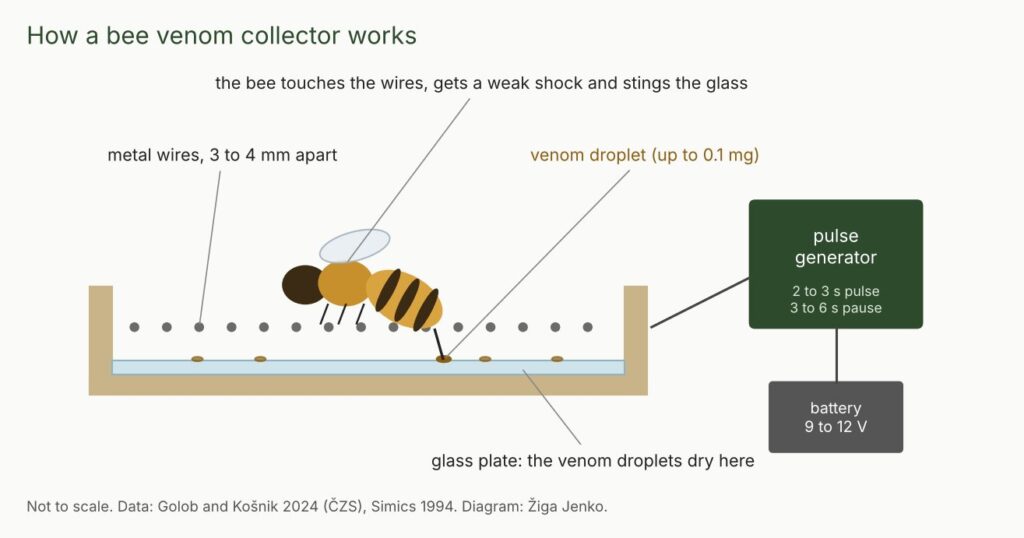
In research devices the voltage on the plate is 18 to 22 V [1]. Only a very small current passes through the bee, because the bee has a very high electrical resistance.
Why the bee survives stinging glass
Each of the two lancets of the sting carries nine or ten backward-pointing barbs. In the elastic skin of a mammal they catch and the sting is torn out; I wrote about this in more detail in the second note. In hard, inelastic glass the barbs do not catch, so the sting is not torn out [23]. The bee releases a droplet of venom, about a third of the contents of the venom sac or up to 0.1 mg, keeps its sting, does not die and can carry on with its work [23].
Why so many bees gather on the plate
When the first bees sting the glass, the others usually react strongly. On stinging, a pheromone is released from the venom and acts as a signal to the other bees in the hive [23]. This alarm odour excites and irritates other bees, which sting as well [61]. Simics describes the smell of fresh venom as similar to ripe bananas [61], and the main component of the sting alarm pheromone is isopentyl acetate [69].
Where in the hive and when
Most devices are designed for collecting at the hive entrance, but some can also be placed inside the hive [23]. In the study Optimising the Technology of Bee Venom Production (2020 to 2022), ČZS compared several positions in LR and AŽ hives [23].
- LR hives: the most venom came from the plate above the top super, in place of the feeder: on average 0.0536 g per colony per collection. Collecting at the entrance came next (0.0433 g), and the plate in place of a comb gave the least [23].
- AŽ hives: the best positions were at the back, behind the combs (0.0162 g), and at the entrance (0.0149 g) [23].
- LR versus AŽ: over three years the average amount in LR hives was 32 % higher. The difference was largest in the second year: LR hives produced 257 % of the amount from AŽ hives, that is, a good 2.5 times as much [23].
- Purity and calm: collecting inside the hive gives fewer impurities, and the bees around the apiary are noticeably less aggressive than when collecting at the entrance [23].
| Hive | Plate position | Yield per colony | What the brochure says about purity |
|---|---|---|---|
| LR | above the top super | 0.0536 g | inside the hive: fewest impurities |
| LR | at the entrance | 0.0433 g | entrance: greater chance of impurities |
| LR | in place of a comb | least (no figure given) | inside the hive |
| AŽ | at the back, behind the combs | 0.0162 g | inside the hive: fewest impurities |
| AŽ | at the entrance | 0.0149 g | entrance: greater chance of impurities |
A Croatian study by Flanjak and colleagues (2021) found no statistically significant difference in melittin content between venom from the entrance and venom from inside the hive. The range was wider for venom from the entrance (51.66 to 69.5 %) than for venom from inside (58.03 to 66.63 %), which the authors attribute to impurities [68, via 23].
When to collect
- Season: from May to the end of July, at the peak of colony development, when there are the most bees. Once long-lived winter bees appear in the colony, we stop collecting [23].
- Weather and forage: we do not collect during a strong nectar flow or in rain, especially not at the entrance. In high outdoor temperatures we do not collect inside the hive [23].
- Duration: most venom is obtained in the first 30 minutes. The brochure gives 30 to 60 minutes as optimal; some collect for 90 to 120 minutes, but yields fall during long continuous collection. In a 2022 trial, 45 minutes gave 22 % more venom than 30 minutes [23].
- Breaks: researchers and beekeepers recommend 3 to 10 days between collections from the same colony. In our conditions, with good colony development and favourable forage and weather, an interval of 5 to 10 days is suitable. In poor weather and forage the interval should be extended or collecting stopped [23].
Does collecting harm the colony
In all three years of the study, ČZS monitored strength, calmness, quality and extent of brood, and food and pollen stores. Colonies from which venom was collected were compared with colonies in the same apiary from which no venom was collected (a control group) [23].
None of the monitored parameters showed a negative effect, nor was there any queen loss, queen supersedure or chalkbrood. The brochure adds that this agrees with other researchers, who observe no effect when the intervals between collections and the duration of collecting are appropriate [23].
Venom yields varied greatly between colonies, even between colonies of similar strength. No clear link with the assessed colony traits was found; only pollen stores in the combs suggested a weak positive relationship. This agrees with Omar (2011), who stresses the importance of pollen intake and stores while the bees from which venom is collected are developing [23].
A bee emerges with a fully developed venom gland but an empty venom sac. The amount of venom in the sac increases until the age of 15 to 20 days, when it holds 0.15 to 0.3 mg [23]. There is more on this in the second note; what matters here is that the venom gland needs protein, which bees get from pollen.
Drying, scraping and storage
Fresh venom is a colourless liquid with an unpleasant bitter taste and a pH of 4.5 to 5.5. It contains 65 to 70 % water [23]. On the glass plate it dries in about 20 minutes at 25 °C. Dried venom still contains 3.75 to 12.66 % water, in Slovenian samples 7.85 % on average [23].
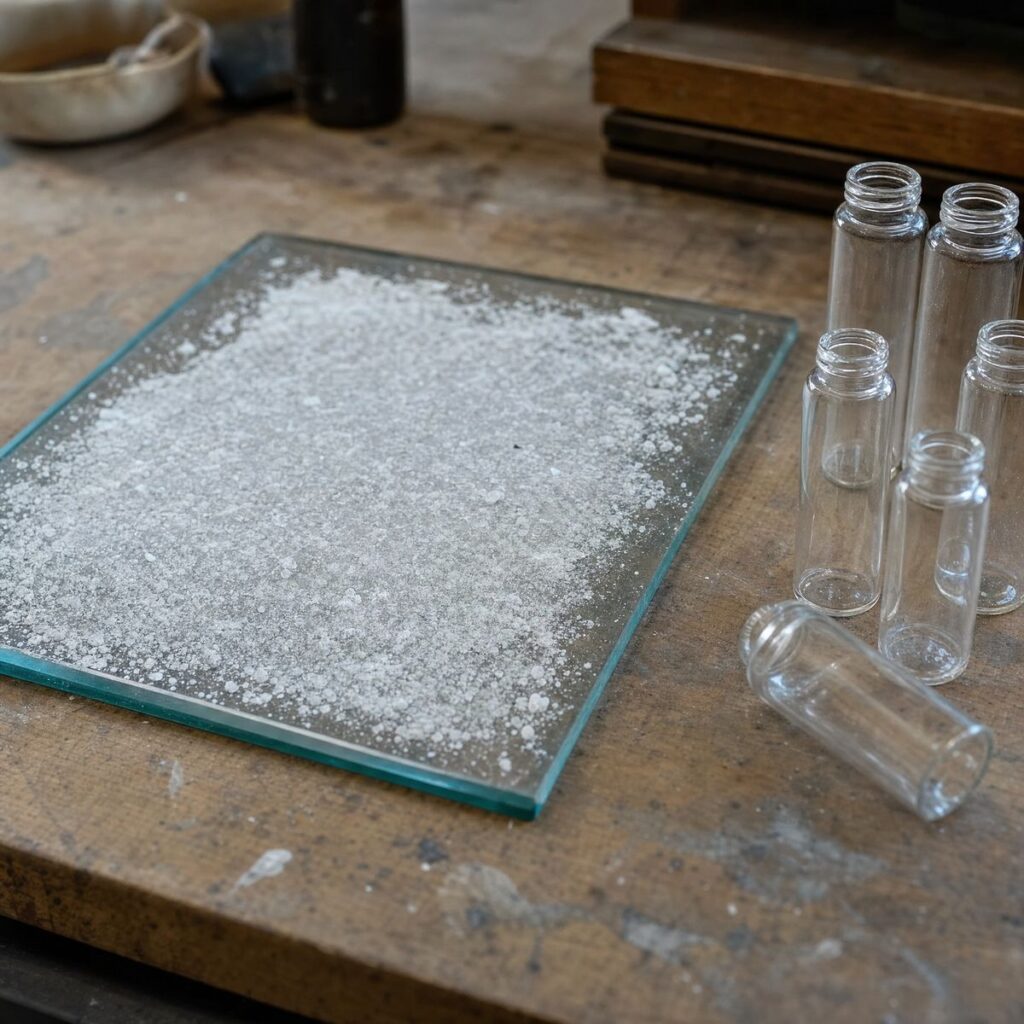
When collecting is over, we switch the device off; the bees usually withdraw within a few minutes [23]. The venom is scraped off the plates with purpose-made scrapers or with an ordinary razor blade, which has proved very effective and is also the cheapest option. We work in a clean, draught-free room, because dried venom is an extremely fine, light powder that even a slight draught can lift. The scraped venom is weighed on a precise scale [23].
Powdered venom is stored in a tightly closed glass or plastic jar in a dark, cool place, usually in the freezer, where it keeps its properties for several years [23]. The best way to preserve quality is lyophilisation (freeze-drying): protected from moisture and oxidation, the venom can be stored for five years or more. It does not lose its toxicity over time, but its effectiveness in apitherapy decreases [23]. Simics states that venom is resistant to freezing and, when dried, withstands even 100 °C [61].
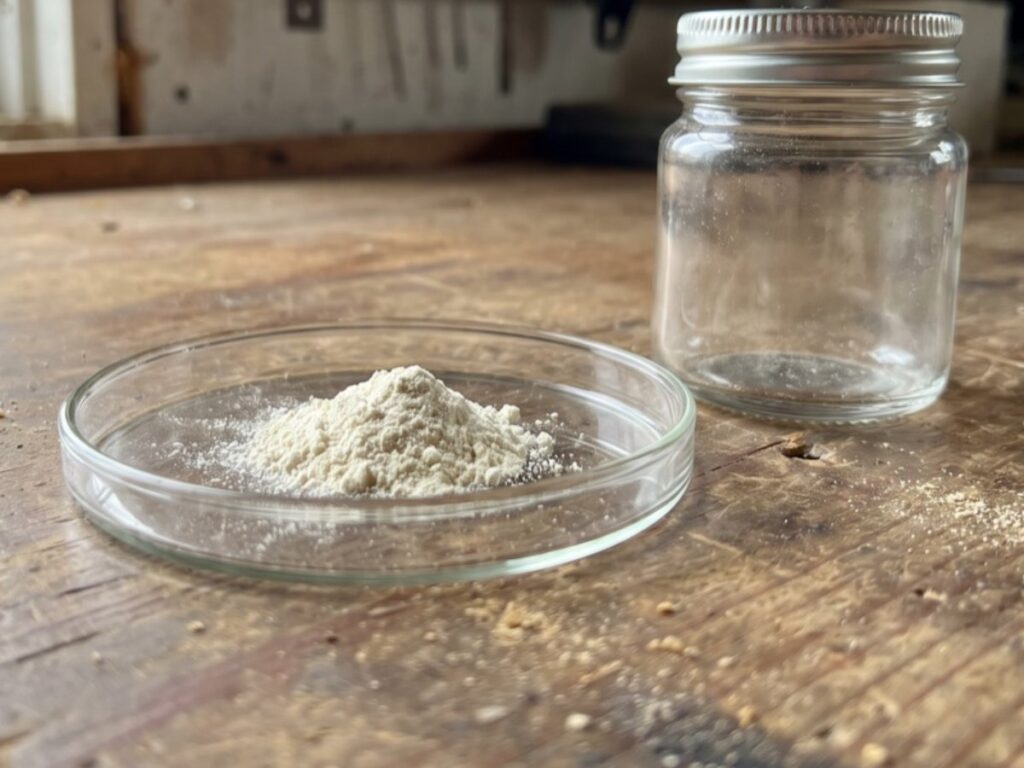
CLEANING WITH ALCOHOL
After every collection and scraping, we wipe the work surfaces, the glass plates and the wires with a cloth and alcohol. Alcohol does not dissolve venom, but it neutralises it [23].
Venom residue on the plates oxidises before the next collection, mixes with the fresh venom and lowers its quality. This often shows in the colour: yellow and brown shades appear in the venom [23].
Venom also builds up on the wires, so the efficiency of the device drops from one collection to the next, even to 10 % [23]. The Maribor course material gives the reason briefly: venom is an insulator [22]. Thin wires are cleaned with a soft cotton cloth or cotton wool so that they are not damaged [23].
Protection at work
During collection the bees are more aggressive, so venom is collected only at apiaries with no other people nearby whom the bees could endanger. The beekeeper wears full beekeeping protection: a suit with a veiled hat, and gloves [23].
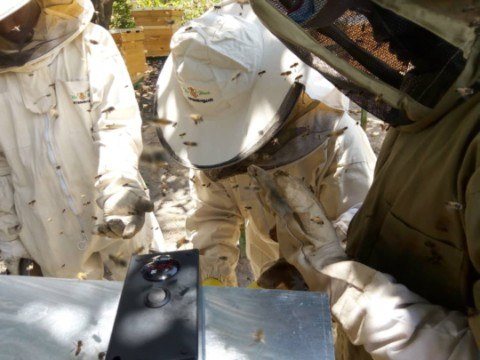
During scraping and weighing the risk is different: the fine powder rises into the air. The brochure recommends [23]:
- latex or nitrile gloves;
- long-sleeved clothing, washed after work;
- safety glasses;
- a filter mask or a full-face mask.
Venom dust irritates the skin and the mucous membranes of the mouth and airways, and in contact with the eyes it can cause permanent damage to sight [23]. What happens in the body after a sting, and when a reaction is dangerous, I describe in the fifth and sixth notes.
Quality: melittin and colour
Melittin is the main peptide of bee venom and also the measure of its quality. Its share varies considerably from sample to sample; the sources cited in the brochure report values from about 27 to 70 % [23]. What melittin is and what it does, I describe in the fourth note; here I treat it only as a measure of quality.
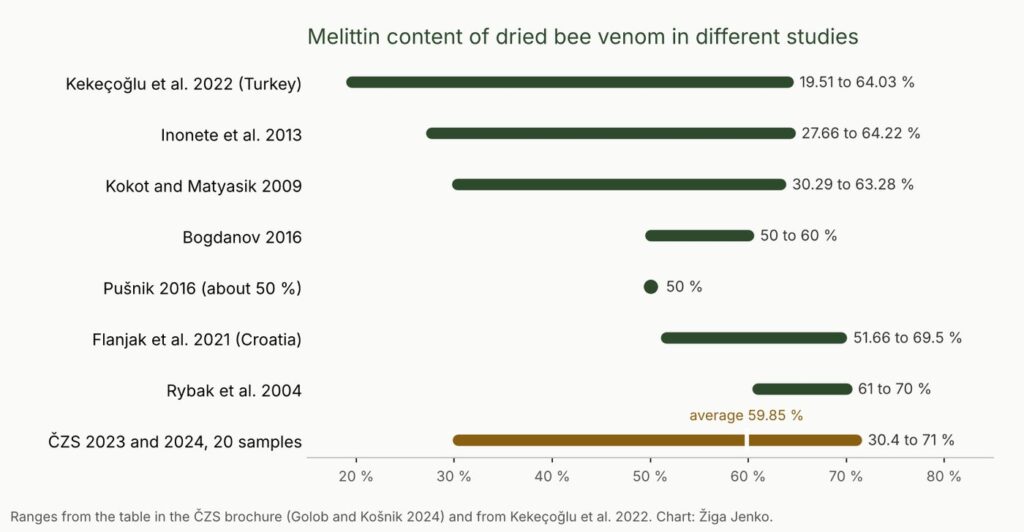
In the study Characterisation of Bee Products, ČZS collected 20 samples of Slovenian venom in 2023 and 2024. The analyses were carried out by the Andrija Štampar Teaching Institute of Public Health in Zagreb, and melittin was determined by liquid chromatography (HPLC). The melittin content ranged from 30.4 to 71 %, with an average of 59.85 %. In 2024, half of the samples contained more than 60 %, namely between 69.4 and 71 %, which the brochure rates as an exceptionally high share compared with foreign studies [23].
A Turkish study collected venom at its own apiary from May to August 2019, during the day at the entrance and inside the hive, and at night inside. No statistically significant differences were found by time of collection, position on the hive or month. However, the samples collected with the same device by beekeepers in five Turkish cities (27 samples) differed significantly: melittin ranged from 19.51 to 64.03 % and apamin from 1.28 to 3.81 %. The authors believe that mistakes in collecting and storage are the most decisive factors for quality [11].
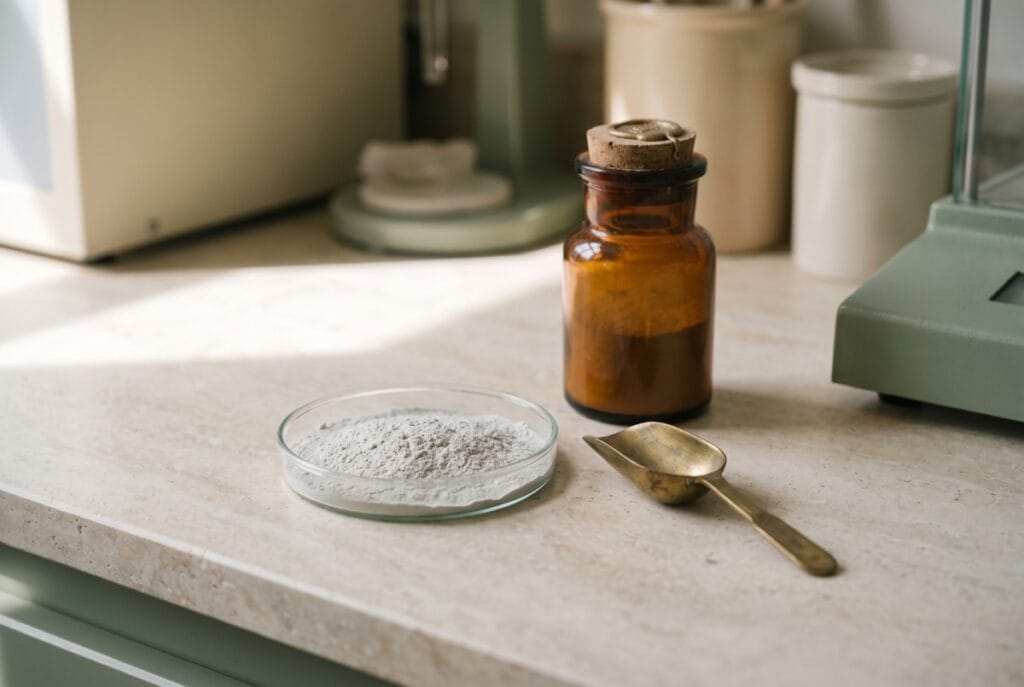
COLOUR TELLS A LOT
Dried bee venom is a fine powder, white, off-white to greyish in colour [23].
Nectar, pollen particles, bee faeces and hive debris colour the venom yellowish or brownish and lower its quality. Oxidation does the same, from improper storage or residue on uncleaned plates [23].
ČZS found a link between the visual score and melittin: samples with less melittin had a poorer score. The eight samples from 2024 that received full marks in the visual assessment contained 70.44 % melittin on average [23].
Next time
In the fourth note I look at what bee venom is made of: melittin, apamin, enzymes and amines, and why it is acidic.
Sources
[1] Gajski G., Leonova E., Sjakste N.: Bee Venom: Composition and Anticancer Properties. Toxins 2024; 16: 117. https://doi.org/10.3390/toxins16030117
[11] Kekeçoğlu M., Çaprazlı T., Tanuğur Samancı A. E., Samancı T., Yorulmaz Önder E.: Factors Affecting Quality of Honey Bee Venom. Journal of Apicultural Science 2022; 66(1): 5 to 14. https://doi.org/10.2478/JAS-2022-0001
[22] Apitherapy Section of the Maribor Beekeepers' Association: presentations Bee Venom 1 to 3 (V. Pušnik and A. Lunežnik, 2020/21). Read as presentations, no online link.
[23] Golob S., Košnik M.: Čebelji strup (Bee venom). Slovenian Beekeepers’ Association, Public Advisory Service in Beekeeping, Brdo pri Lukovici 2024 (ISBN 978-961-6516-93-8). No web link; the booklet exists in print and PDF; I read the PDF.
[61] Simics M.: Bee Venom: Exploring the Healing Power. Apitronic Publishing, Richmond (B. C.) 1994. No online link (PDF).
[67] Benton A. W., Morse R. A., Stewart J. D.: Venom Collection from Honey Bees. Science 1963; 142(3589): 228 to 230. I read only the abstract. https://doi.org/10.1126/science.142.3589.228
[68] Flanjak I., Kovačić M., Primorac L., Soldić A., Puškadija Z., Bilić Rajs B.: Comparison between the quantity and quality of honey bee venom collected in the front and inside of the hive. Journal of Apicultural Research 2021. I have not read the article; the data are taken from [23]. https://doi.org/10.1080/00218839.2021.1994262
[69] Urlacher E., Francés B., Giurfa M., Devaud J.-M.: An alarm pheromone modulates appetitive olfactory learning in the honeybee (Apis mellifera). Frontiers in Behavioral Neuroscience 2010; 4: 157. https://doi.org/10.3389/fnbeh.2010.00157